
Learning how to adjust a martingale collar properly is one of the most useful skills a dog owner can pick up, because a martingale only does its job — staying snug enough that a narrow-headed dog can’t back out of it — when it’s fitted correctly. I fumbled my way through my first martingale adjustment years ago, made it way too loose, and watched my dog slip it right over her ears at a trailhead. Once I understood how the two loops work together, fitting one took about two minutes.
This guide walks you through sizing, the step-by-step adjustment process, the two-finger check, and the mistakes I see owners make most often, so your dog’s collar ends up safe and comfortable from the first wear.
How a Martingale Collar Works
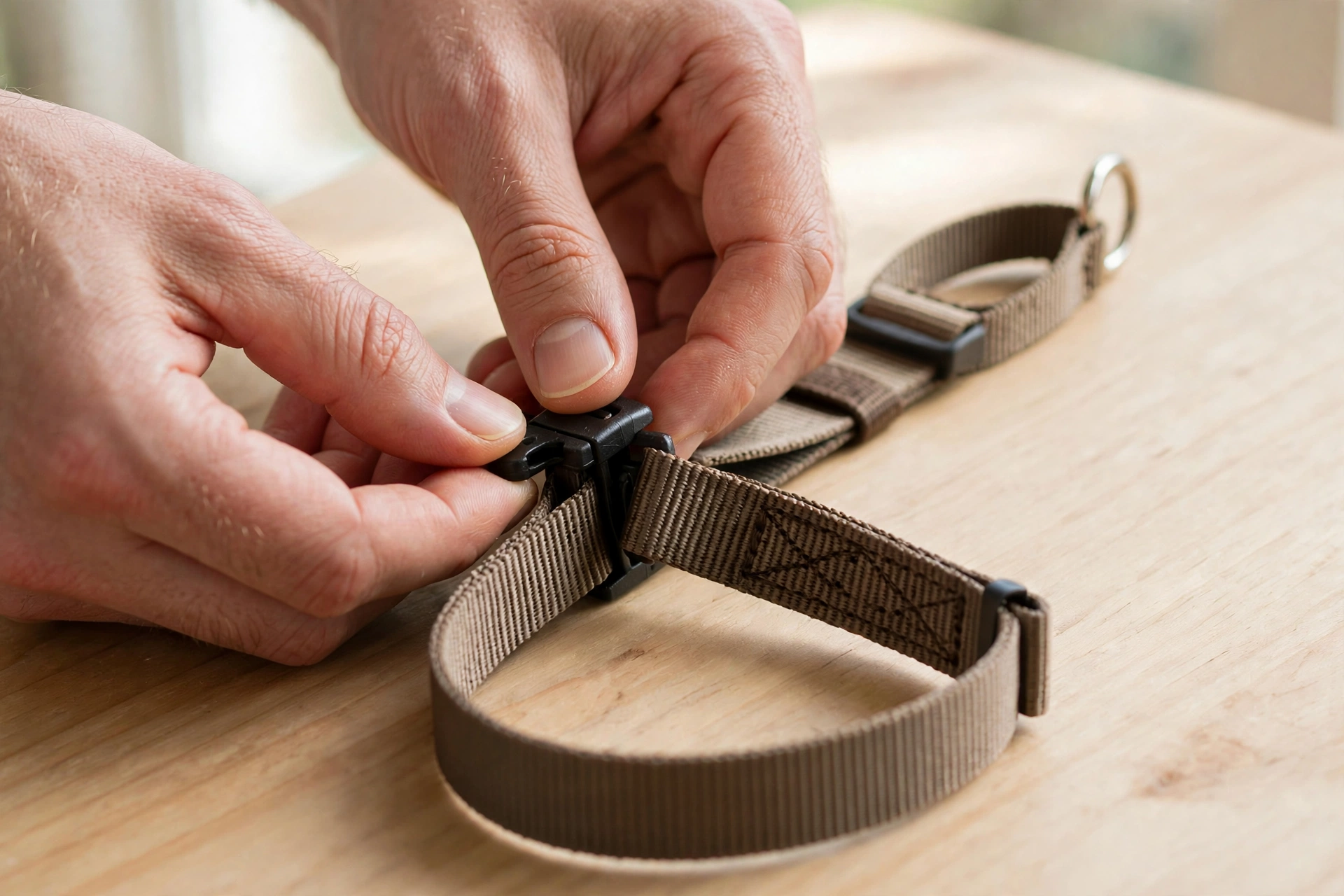
A martingale — sometimes called a limited-slip collar — is made of two loops instead of one. The larger loop goes around your dog’s neck like a normal collar, and the smaller “control loop” has the D-ring where you clip the leash. When the dog pulls or tries to back out, the leash tightens the control loop, which gently snugs the main loop around the neck. When the dog relaxes, the collar loosens back up.
The adjustment slider sits on the main loop. Moving it changes the resting circumference of the collar, which determines how tight the collar can get when the control loop pulls closed. That adjustment is the entire game: too loose, and the collar slips off; too tight, and it never gets the slack it’s supposed to have.
Getting the Right Size Before You Adjust
A martingale collar should be sized to your dog’s actual neck measurement, not their weight. Measure around the middle of the neck with a soft tape measure, then add about two inches — this is the size you want for the collar’s resting length. Most martingale collars have an adjustable range (for example, 14–20 inches), so pick the range that contains your dog’s neck measurement comfortably, not at the extreme end of the slider.
If you’re between sizes, size up. You can always snug the slider down, but a slider maxed out at the end of its travel has nowhere to go as the collar settles, and a growing puppy will outgrow a too-small collar in weeks.
Step-by-Step: How to Adjust a Martingale Collar
- Slide the collar over your dog’s head
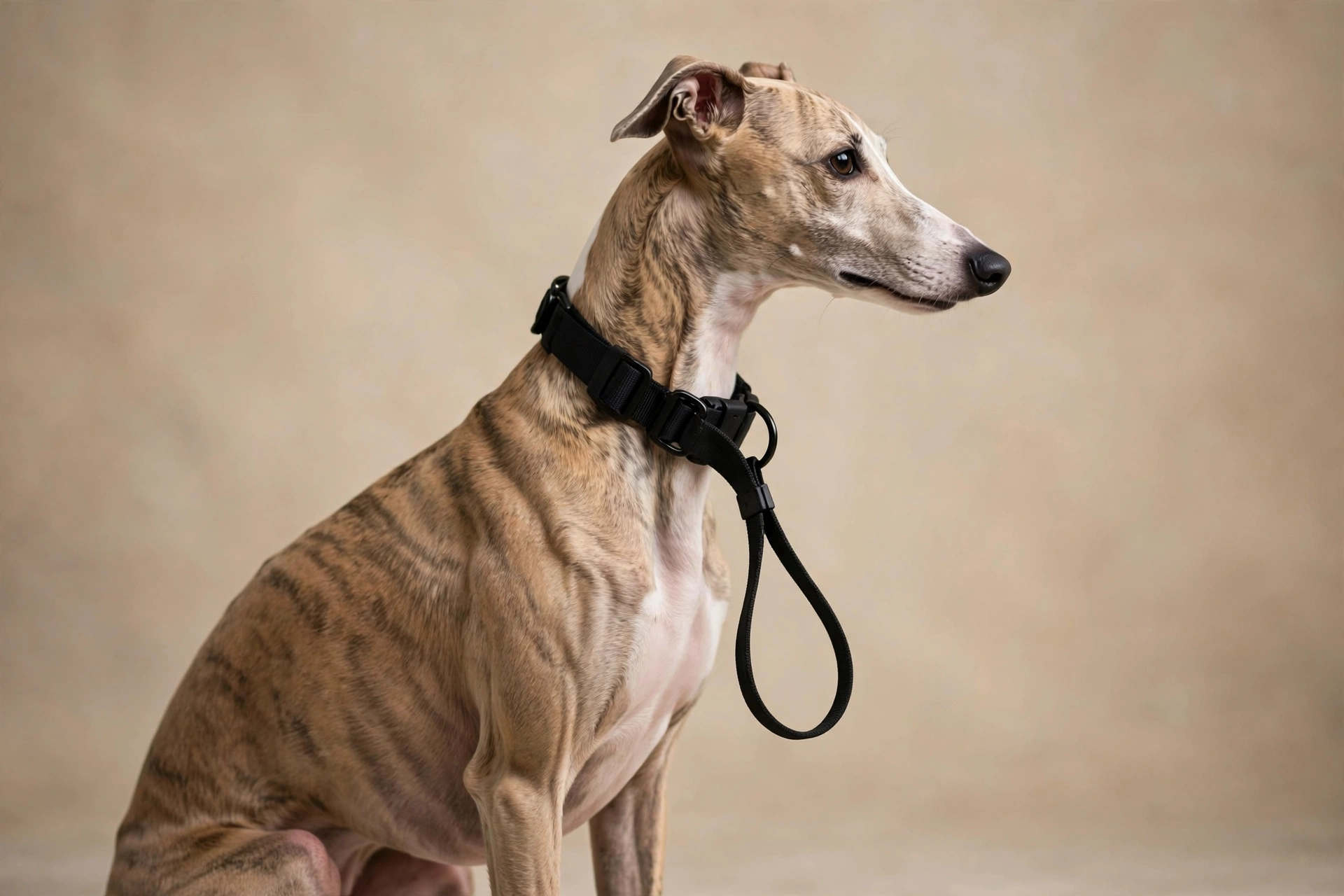
Martingales don’t buckle on like flat collars — they slip over the head, which is why they were originally designed for sighthounds like Greyhounds and Whippets with heads narrower than their necks. Loosen the slider fully first so the opening is generous, then slip it over your dog’s head and settle it at the middle of the neck, roughly where a flat collar would sit.
- Position the control loop correctly
Check that the smaller control loop sits flat along the top or side of the neck and isn’t twisted around the main loop. The two metal rings where the loops meet should sit roughly opposite each other, and the D-ring on the control loop should hang centered. A twisted control loop binds instead of sliding, which makes the collar feel jerky when the leash tightens.
- Tighten the slider gradually
With the collar on your dog, pull the adjustment slider to take up slack evenly on both sides. Do this in small increments — slide, check, slide again — rather than yanking it tight in one go. You’re aiming for a snug but comfortable resting fit.
- Do the two-finger check
With the leash unclipped and the collar at rest, you should be able to slide two fingers flat between the collar and your dog’s neck with mild resistance. If two fingers slide through with room to spare, tighten a notch. If you can’t get two fingers under it comfortably, loosen it. Then pull the control loop closed the way a leash would: the two metal rings at the ends of the control loop should just about meet (within an inch) without the main loop crushing the neck.
How to Tell When the Fit Is Right
A correctly adjusted martingale collar does three things: it stays put when the dog pulls forward, it tightens when the dog backs up without the dog escaping, and it loosens completely when the leash is slack. The real test is the back-up test: have someone gently pull the leash while the dog tries to back away (on grass, gently, for a second or two). If the collar holds and the control loop’s rings come close together without touching and digging, you’ve nailed it.
Common Adjustment Mistakes I See
Leaving it too loose. The number-one mistake. Owners fit martingales like loose flat collars, then the dog backs out of it exactly when it matters — near traffic, at the vet, at a trailhead. If your dog can pull the collar over their ears while backing up, it’s too loose.
Fitting it like a tight flat collar. A martingale at rest should be snug, not tight. If there’s no slack left in the control loop, the collar can’t do its gentle-tighten trick and becomes a constant-pressure collar instead.
Twisting the control loop. This one is easy to miss. A twist in the control loop or the webbing stops the sliding mechanism, so the collar either jams or tightens unevenly. Lay it flat and straighten it before every fitting.
Forgetting to re-adjust. Collars stretch, dogs gain and lose weight, and winter coats add inches. Check the fit every few weeks and after any big coat change.
When to Re-Adjust Your Martingale
Re-check the fit whenever you bathe or groom your dog, after seasonal coat changes, if the collar has been through the wash, and any time you notice it riding up toward the ears or spinning freely around the neck. For puppies, I check weekly — they outgrow settings fast, and a collar that was perfect last month can be dangerously tight this month.
Frequently Asked Questions
How tight should a martingale collar be when the leash pulls?
When the leash is taut, the control loop should draw the two end rings to within about an inch of each other. The collar should feel firm but not crushing — you should still be able to work a finger under the tightened collar. If the rings slam together hard with no gap, the resting adjustment is too loose.
Can my dog wear a martingale collar all day?
Most trainers and vets recommend removing any training-style collar when the dog is unsupervised, crated, or playing off-leash with other dogs. A martingale’s control loop can snag on crate wires, branches, or another dog’s jaw. I use martingales for walks and outings, and a simple flat collar with ID tags for around the house.
Where should the control loop sit on the neck?
The control loop should lie flat along the top or the side of the neck with the D-ring roughly centered. It shouldn’t hang down under the throat or bunch up behind the ears. If it migrates, the main loop is probably too loose.
My dog’s martingale keeps loosening. What do I do?
Some smooth nylon webbing slips through sliders over time, especially on active dogs. Re-check before every walk, and if it keeps creeping, look for a collar with a locking slider or a different weave. A tiny drop of clear nail polish on the slider webbing is an old handler trick to add grip — just keep it away from the dog’s skin.
Is a martingale collar okay for puppies?
Yes, as long as it’s sized correctly and re-adjusted frequently as the puppy grows. Because martingales tighten when a puppy pulls, they’re actually useful for teaching loose-leash manners without the escape risk of a flat collar on a wiggly pup.
Related Reading
- What Is a Limited Slip Dog Collar? — the full explainer on how these collars work
- Prong Collar vs Martingale Collar — how martingales compare to prong collars




7 Comments