
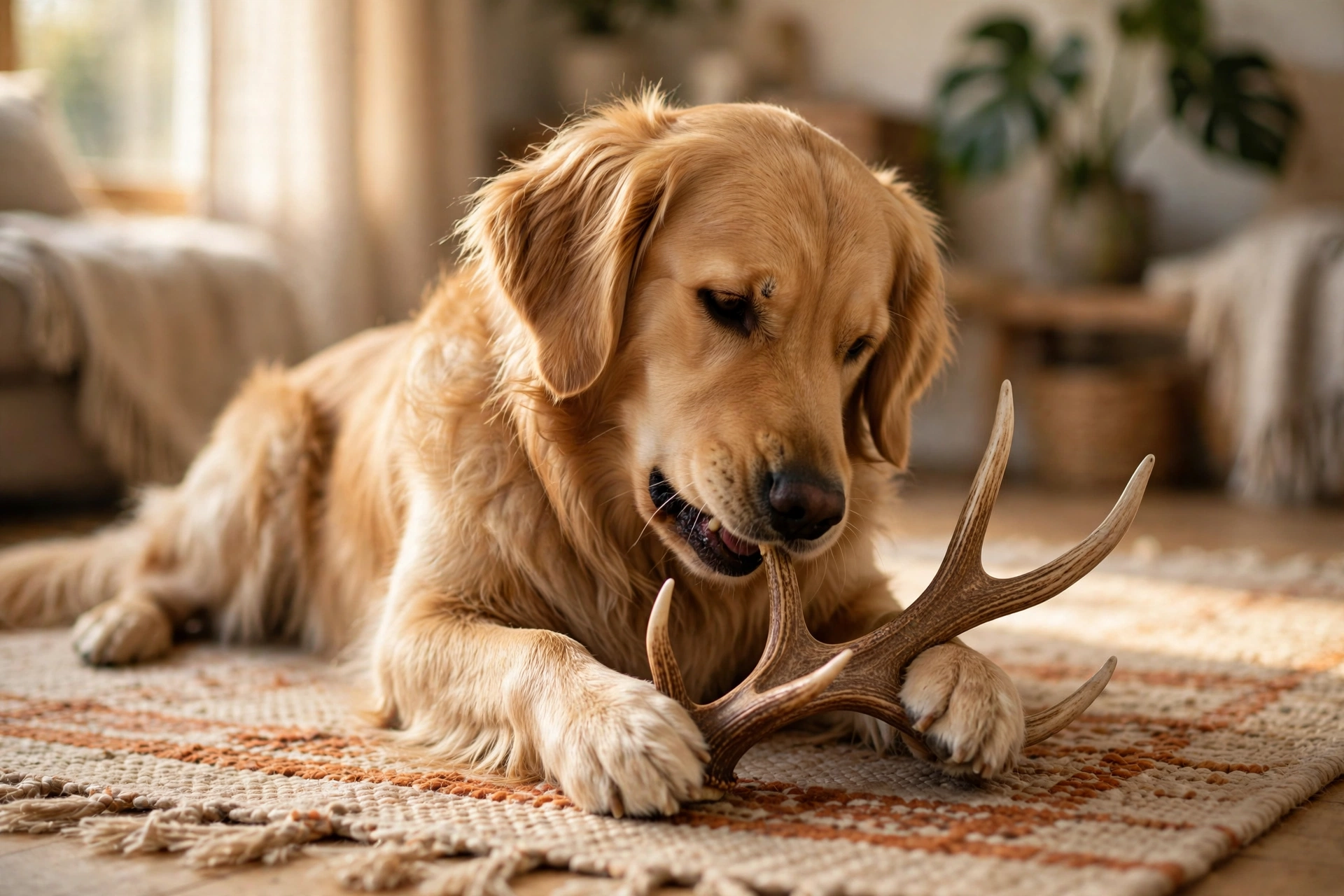
Finding the best antler chews for dogs can feel like a trivia quiz: elk or deer? Whole or split? Grade A or the bargain-bin bag? The answers genuinely matter, because a chew that’s too hard for a sensitive mouth can crack a tooth, while the wrong size can turn an expensive chew into a choking hazard. Antlers are among the longest-lasting natural dog chews you can buy — naturally shed each spring, mineral-rich, odorless, and virtually calorie-free — but they’re also one of the hardest chews you’ll ever hand your dog. In this guide, I break down exactly how elk, deer, and moose antlers compare, who should get a split cut versus a whole one, how to size an antler to your dog, and my six top picks available on Amazon.
Affiliate disclosure
As an Amazon Associate, Dogslifelearning earns from qualifying purchases. If you buy through a link on this page, we may earn a commission at no extra cost to you — which helps us keep testing and publishing independent buying guides.
⚡ The short answer
🥇Heartland Premium Elk Antler Dog ChewsBest Overall→🥈Devil Dog Pet Co Split Elk Antlers (Medium, 2-Pack)Best Split Elk for Beginners→🥉Mighty Paw Elk Antlers (Whole, Large 8″+, 2-Pack)Best for Power Chewers→
The Short Answer: Which Antler Chew Should You Buy?
If you just want the quick verdict before diving into the details:
- Most dogs: Whole or split elk antler, sized up one notch. Elk hits the sweet spot — hard enough to last weeks, slightly softer than deer, and widely available from reputable US sellers.
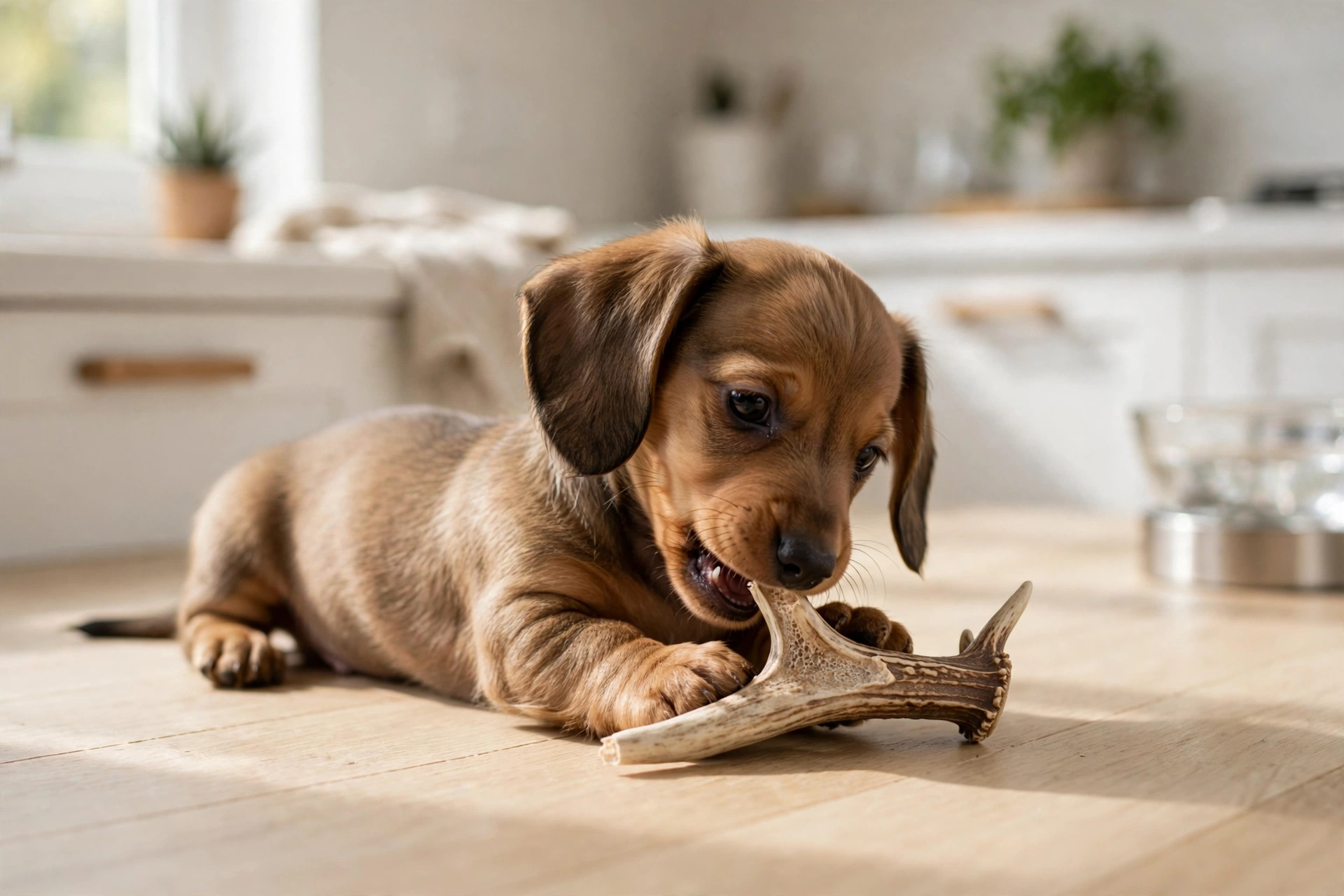
- Puppies, seniors, first-timers, and gentle chewers: Split elk antler. The exposed marrow gives instant flavor and requires far less jaw pressure.
- Extreme power chewers with healthy teeth: Whole deer antler. Deer is the hardest of the common antler types, so reserve it for confident adult dogs under supervision.
- Seniors with dental work: Consider a softer moose antler, or skip antlers for a digestible chew like a yak chew.
Top 6 Antler Chews for Dogs (2026)
Heartland Premium Elk Antler Dog Chews
Heartland Premium is the name that comes up most often in owner communities, and for good reason: Grade A, naturally shed Rocky Mountain elk antlers, hand-selected and sold in clearly labeled sizes by dog weight. The dense outer cortex stands up to aggressive chewers for weeks, and the antlers arrive with a rich brown color that signals fresh, moisture-retaining bone rather than sun-bleached, brittle stock. No odor, no mess, no additives. A veteran-owned, US-based operation.
- Type: Elk • Cut: Whole (split options available) • Sizes: Small to XL (8″+)
- Best for: Most dogs — the safest “just get this one” pick.
- Watch out: Premium pricing per piece; size up if you’re between sizes.
Devil Dog Pet Co Split Elk Antlers (Medium, 2-Pack)
For a first-timer, this is the introduction I’d buy. Devil Dog Pet Co’s splits are cut lengthwise to expose the marrow — the flavor center dogs work toward — so even picky or tentative chewers engage immediately. The brand sells only Grade A, wild-shed Rocky Mountain elk, collected by shed hunters each spring, and the medium 2-pack (5″+ each) suits most dogs in the 20–45 lb range. Their listings even advise supervising and removing the chew when it gets swallowable, which is exactly the safety posture you want from a brand.
- Type: Elk • Cut: Split • Sizes: Small through XL
- Best for: First-time antler users, teething puppies (6+ months), seniors, picky eaters.
- Watch out: Splits wear faster than wholes — budget for replacements sooner.
Mighty Paw Elk Antlers (Whole, Large 8″+, 2-Pack)
When your dog destroys “indestructible” toys in an afternoon, you want maximum durability per dollar. Mighty Paw’s 2-pack of whole large elk antlers (8″+ each) delivers exactly that: full-density whole cuts with the marrow sealed inside, forcing the dog to work for it over weeks. Naturally shed, USA-sourced, low-odor. The whole cut is the longest-lasting format, and a two-pack keeps a backup in rotation while one rests.
- Type: Elk • Cut: Whole • Sizes: Medium to Large (8″+)
- Best for: Power chewers and large breeds with strong, healthy teeth.
- Watch out: Not for beginners, puppies, or dogs with dental issues — graduate to this, don’t start here.
WhiteTail Naturals Deer Antler Dog Chews (Medium, 3-Pack)
Deer antler is the hardest of the common antler types, which makes it the maximum-durability option for experienced, aggressive chewers — and a poor choice for puppies, seniors, or dogs with sensitive teeth. WhiteTail Naturals sells hand-selected, naturally shed Texas whitetail deer antler, custom-cut with edges sanded smooth. The 3-pack of mediums (5–6″) is good value for medium-to-large dogs who’ve already proven they can handle hard chews responsibly.
- Type: Deer (whitetail) • Cut: Whole • Sizes: Small through Jumbo XXL
- Best for: Confident adult power chewers who finish elk too quickly.
- Watch out: Hardest common antler — supervise closely and retire at the first sign of aggressive downward biting.
Buck Bone Organics Elk Antler Dog Chews (1 lb Bag, Split + Whole Mix)
If you’re buying for multiple dogs — or one very determined dog — buying by weight beats buying by piece. Buck Bone Organics’ 1 lb bag mixes split and whole Grade A elk chews (roughly 3–4 medium-large pieces, 5–8″), so a single purchase lets you test both cuts and see which your dog prefers. Wild-shed in the Rockies each spring, hand-cut and sanded, made in the USA since 2015. The mixed bag doubles as a trial kit: if your dog ignores the whole pieces but loves the splits, you know exactly what to reorder.
- Type: Elk • Cut: Mixed (split + whole) • Size: ~1 lb bag, 30–60 lb dogs
- Best for: Multi-dog homes, finding your dog’s preference, stocking up.
- Watch out: Mixed pieces vary in shape and density — that’s natural, but supervise each new piece.
Elkhorn Premium Chews Small Split Twin Pack
Small dogs and puppies get the short end of the antler market, so a properly sized twin pack matters. Elkhorn’s small split pieces (4–6″) are cut for dogs up to 20 lbs, exposing the marrow so even tiny jaws can engage without straining. Premium-grade, naturally shed, USA-sourced, hand-cut with smoothed edges. Split is the right call here: small-breed teeth are proportionately more vulnerable, and the easier chew keeps things safe and satisfying.
- Type: Elk • Cut: Split • Size: Small (4–6″, up to 20 lbs)
- Best for: Small breeds, puppies 6+ months, gentle first-timers.
- Watch out: Not for power chewers — a determined medium dog will chew through these fast.
Antler Chews Compared: Quick Reference
| Product | Antler Type | Cut | Size Range | Best For |
|---|---|---|---|---|
| Heartland Premium | Elk | Whole | Small–XL (8″+) | Best overall; most dogs |
| Devil Dog Pet Co | Elk | Split | Small–XL (5″+) | Beginners, puppies, seniors, picky eaters |
| Mighty Paw | Elk | Whole | Medium–Large (8″+) | Power chewers, large breeds |
| WhiteTail Naturals | Deer | Whole | Small–XXL | Experienced aggressive chewers only |
| Buck Bone Organics | Elk | Mixed | 1 lb bag, 30–60 lb dogs | Value; testing both cuts |
| Elkhorn Premium Chews | Elk | Split | Small (4–6″) | Small dogs & puppies up to 20 lbs |
Buying Guide: How to Choose the Right Antler Chew
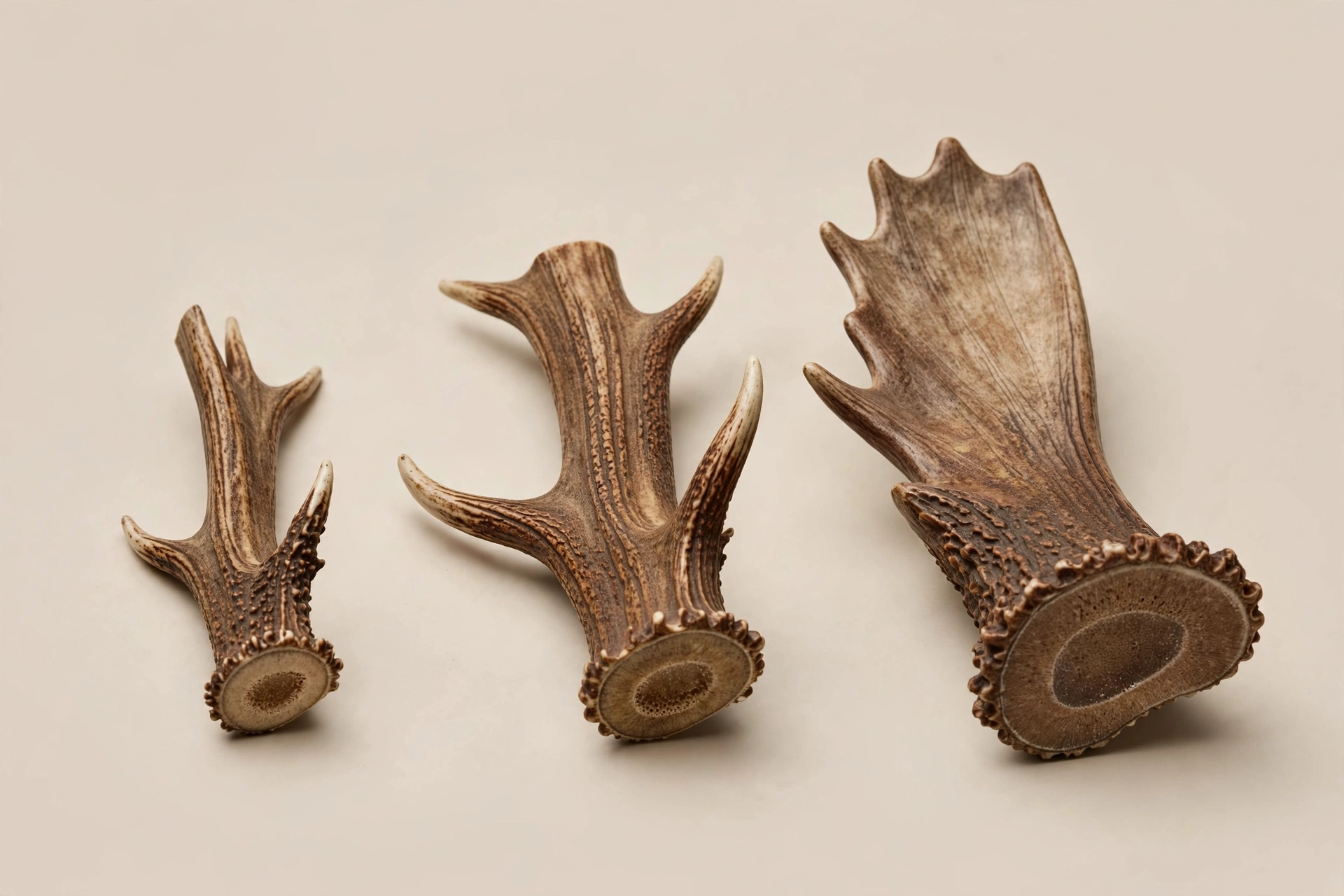
Elk vs Deer vs Moose: How the Antler Types Compare
All three come from naturally shed antlers (the animal grows and drops them annually, so no animal is harmed when they’re collected properly). What differs is density, hardness, and marrow content:
| Antler Type | Hardness | Typical Durability | Best For |
|---|---|---|---|
| Elk | Hard | 3–8+ weeks | Most dogs; the balanced all-rounder |
| Deer | Hardest, most brittle | 1–3 weeks of heavy chewing* | Experienced adult power chewers only |
| Moose | Moderate; high marrow | 1–2 weeks | Seniors and dogs needing a gentler texture |
*Durability figures vary enormously with chew style — a gentle nibbler can make a deer antler last months, while a true power chewer grinds any antler down faster. The key variable is density: deer antler is the hardest and most brittle, elk sits in the middle with a dense outer cortex and generous marrow core, and moose is the softest with the highest marrow content. Only give deer antlers to dogs with healthy adult teeth and controlled chewing habits — never to puppies or seniors.
Whole vs Split: Which Cut Wins?
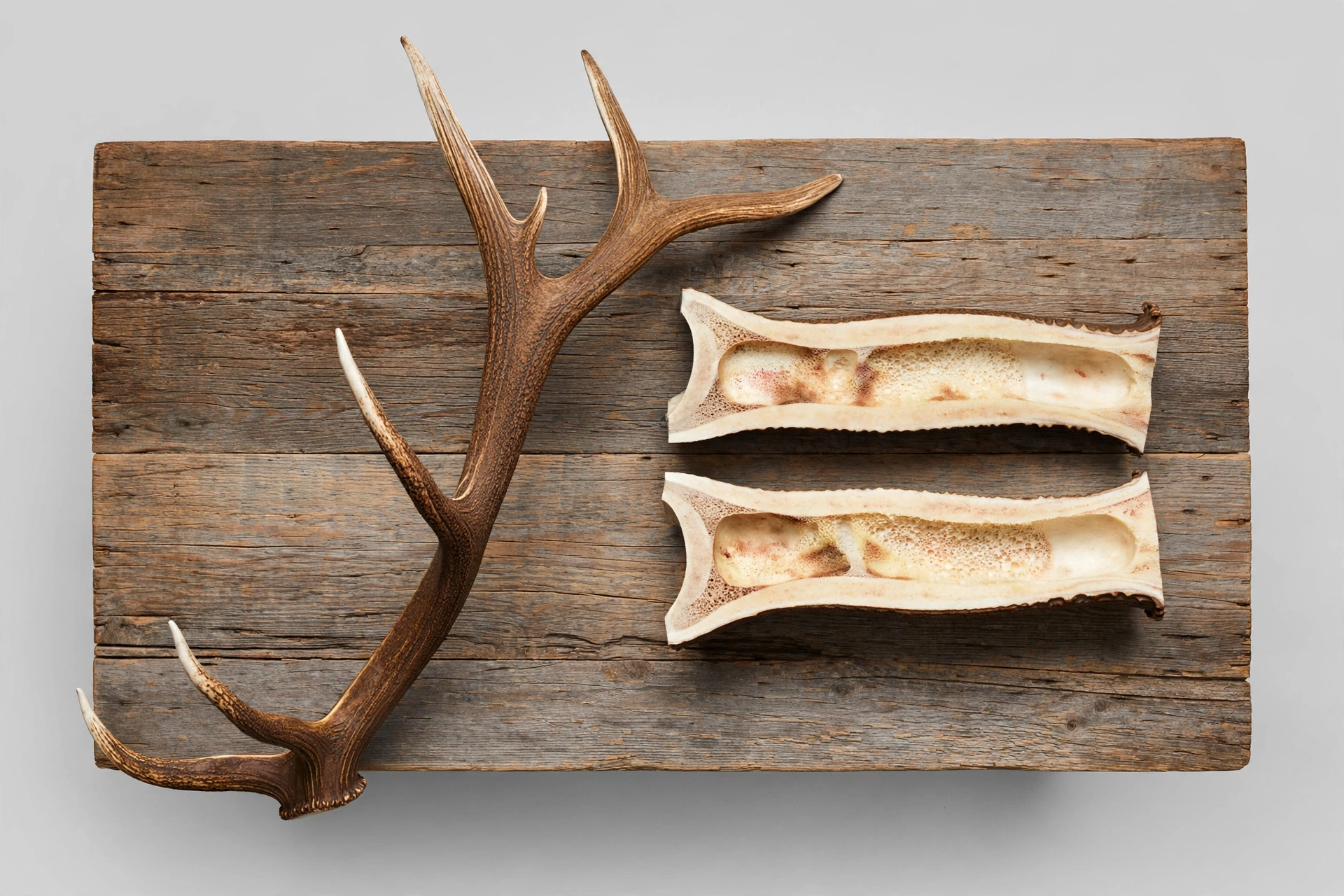
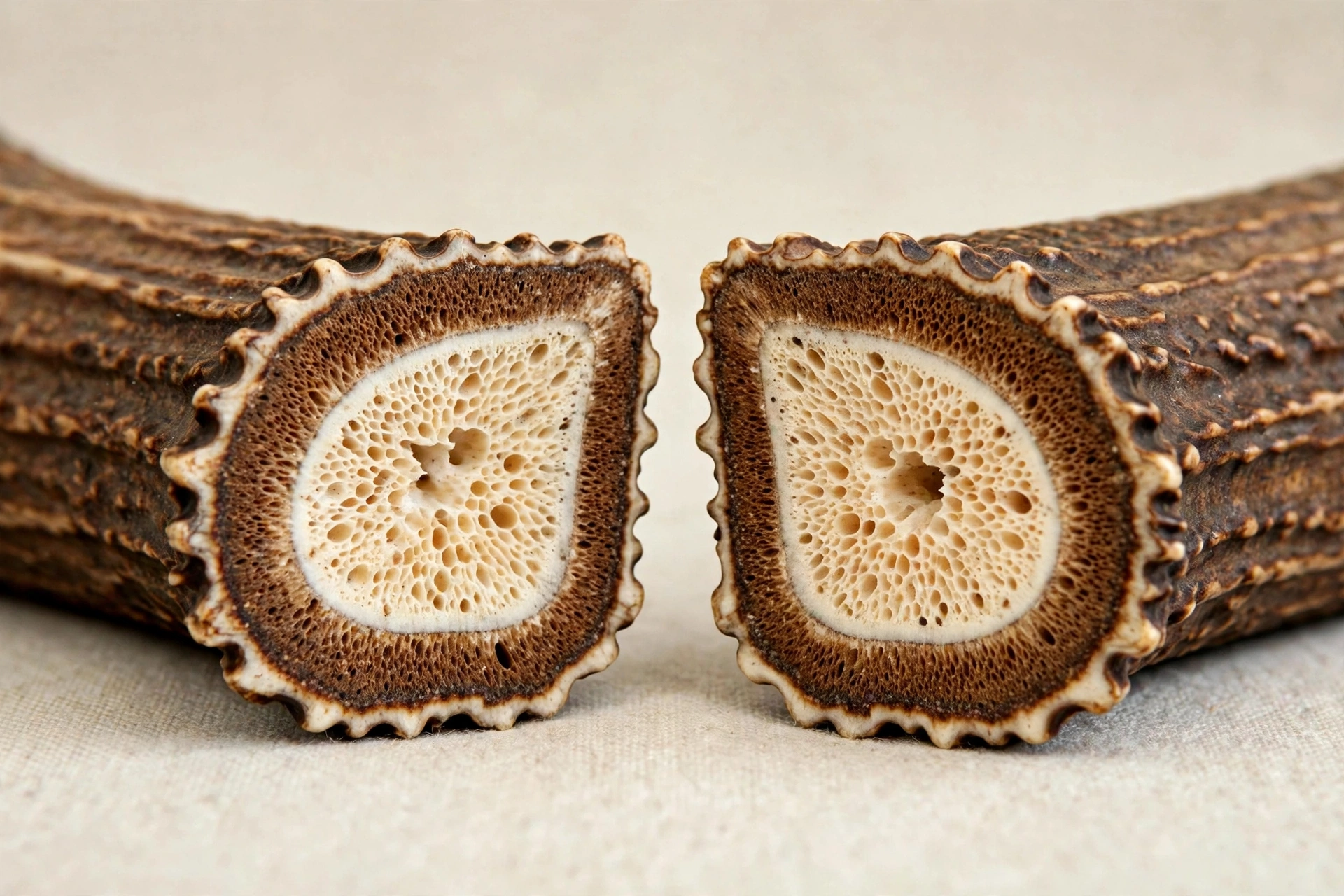
A split antler is cut lengthwise to expose the inner marrow — the nutrient-rich “prize” at the center. A whole antler keeps that marrow sealed inside a dense outer shell. Neither is universally better; the right cut depends on your dog:
| Feature | Split | Whole |
|---|---|---|
| Marrow access | Immediate — visible and tasty | Earned — dog works for it over time |
| Durability | 2–4 weeks | 4–8 weeks (sometimes months) |
| Best for | Puppies 6+, seniors, beginners, picky eaters, gentle chewers | Power chewers, experienced antler users, large breeds |
| Tooth risk | Lower — less force needed | Higher if chewed aggressively |
| Engagement | High initial interest | Sustained long-term challenge |
The smart strategy, used by experienced owners: start every dog on a split antler. If your dog finishes splits in under a week and craves more challenge, graduate to a whole. If they’re happy on splits, stay there — the best antler is the one your dog safely enjoys, not the hardest one you can buy.
Sizing: Match the Antler to the Dog (Size Up When in Doubt)
| Dog Weight | Recommended Cut | Example |
|---|---|---|
| Under 20 lbs | Small split elk | Elkhorn small split; Heartland small |
| 20–45 lbs | Medium whole or split | Devil Dog split 2-pack; Buck Bone Organics bag |
| 45–70 lbs | Large whole or split | Heartland large whole; WhiteTail large |
| 70+ lbs | XL / XXL whole | Mighty Paw large whole 2-pack |
The non-negotiable rule: the antler must be longer than your dog’s muzzle and impossible for the dog to fit entirely in its mouth. An undersized antler is a choking hazard, not a bargain — when in doubt, size up.
Dental Safety: The Honest Part Most Articles Skip
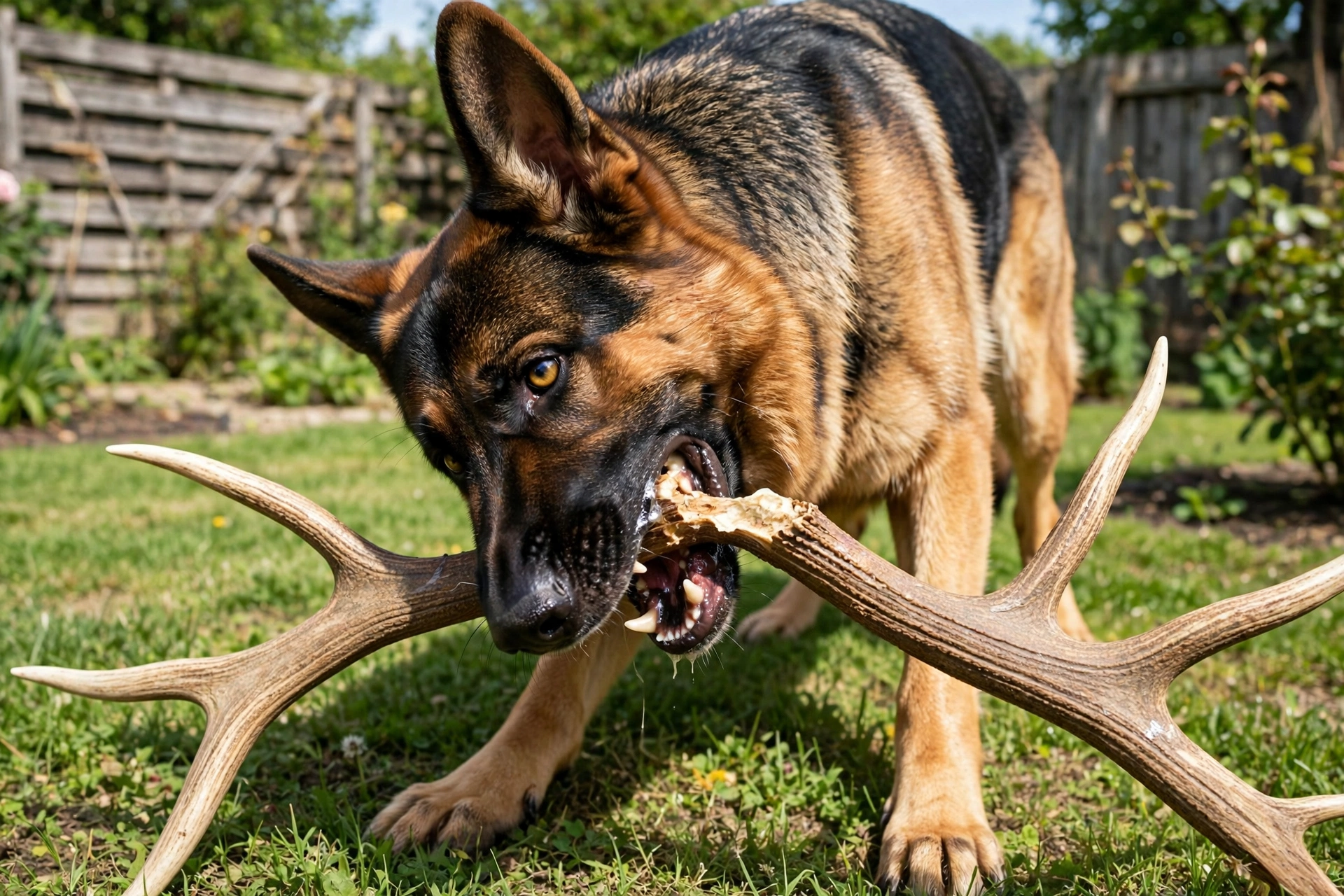
Antlers are extremely hard, and hardness is the trade-off you accept for weeks of chew time. Veterinary dental specialists routinely warn that any chew harder than the tooth itself can cause a slab fracture — typically of the large upper carnassial teeth — especially in dogs that bite straight down rather than gnawing from the side. That doesn’t mean antlers are “bad”; it means they demand respect. Follow these rules:
- Supervise every session. Watch how your dog chews: side-gnawing is the safe technique; hard downward biting or audible “crunching” is your cue to intervene or switch to a softer chew.
- No puppies under 6 months. Baby teeth are too delicate for hard chews. From 6–12 months, split elk only.
- Keep sessions to 10–20 minutes for new or enthusiastic chewers, then put the antler away — limited access keeps it exciting and limits dental stress.
- Discard before it gets small. Retire any antler that becomes short enough to fit in the mouth or develops cracks and sharp edges.
- Check teeth regularly. Reluctance to chew, drooling, bleeding gums, or pawing at the mouth all mean a vet visit — and a switch to a softer chew.
- Seniors and dental patients: stick with split elk or a softer moose antler, and ask your vet first if your dog has significant dental disease.
Sourcing & Quality: How to Spot a Good Antler
- Grade A matters. Look for antlers described as Grade A: dense, structurally sound, and rich brown in color — brown signals fresh shedding and retained moisture. Chalky white antlers are old, dried out, and more brittle.
- Naturally shed, not farmed or cut live. Reputable sellers state plainly that antlers are wild-shed (collected after the animal drops them) — elk naturally shed annually, typically in spring.
- No bleach, dyes, or chemical treatments. Bleached-white antlers look “clean” but have lost minerals and structural integrity.
- Sanded edges. Quality sellers cut and hand-sand every piece to remove jagged points.
- Traceable sourcing. “Sourced in the USA” from Rocky Mountain elk or Texas whitetail deer is a good sign; vague “imported” origins are not.
Introducing Antlers and Keeping Them in Good Shape
Rub a new antler with a little bone broth or peanut butter to spark interest, and soak a disinterested antler in warm water for a few minutes to reactivate its scent. Rotate chews weekly to maintain novelty. To clean, rinse under warm water with a bristle brush — never use soap or bleach, and never boil or bake antlers (heat makes them brittle). Air-dry fully, store in a dry, ventilated spot, and replace every 3–6 months regardless of appearance.
Frequently Asked Questions
Are antler chews safe for dogs?
Yes, when chosen correctly. Antlers are naturally shed, single-ingredient, splinter-resistant, odorless, and low-calorie. The two safety rules are non-negotiable: always supervise chewing sessions and size the antler larger than your dog’s mouth. Discard pieces that become swallowable or cracked, and choose softer cuts for puppies and seniors.
Should I choose elk or deer antlers for my dog?
For most dogs, elk. Elk antlers offer the best balance — dense enough to last weeks but slightly softer than deer, with a generous marrow core. Deer antlers are the hardest and most brittle, making them suitable only for experienced adult power chewers with healthy teeth. When in doubt, choose elk.
Split or whole antler — which is better?
Neither is universally better. Split antlers expose the marrow for instant flavor, making them ideal for puppies, seniors, beginners, and gentle chewers. Whole antlers hide the marrow inside a dense shell, lasting far longer — they’re built for power chewers and experienced antler users. Start with split; graduate to whole only if your dog finishes splits too quickly.
Can puppies chew antlers?
Not before 6 months — baby teeth are too delicate for hard chews. From 6–12 months, offer split elk antlers only, in short supervised sessions of 10–20 minutes, and watch for bleeding gums. After 12 months, with adult teeth fully in, you can gradually introduce whole antlers if your dog’s chewing style is controlled.
Will antlers break my dog’s teeth?
They can, in the wrong circumstances. Veterinary dentists warn that very hard chews can cause slab fractures of the upper carnassial teeth, especially in dogs that bite straight down. Reduce the risk by sizing up, supervising, choosing split cuts for softer chewing, and retiring worn pieces. Dogs with dental disease should get vet approval first.
When should I replace an antler chew?
Replace it when the piece becomes short enough to fit entirely in your dog’s mouth (a choking hazard), or when it develops cracks or sharp edges. Also retire antlers showing heavy wear or after 3–6 months regardless of condition, for hygiene. A common rule of thumb: if it could fit between the back molars or be swallowed, it’s done.
Related Buying Guides
The verdict
Antlers earn their place as one of the best long-lasting dog chews — but only when you match the type and cut to the dog. For most owners, the winning formula is simple: start with a split elk antler, size up, and supervise. If your dog powers through splits and has healthy adult teeth, move up to a whole elk — and only consider deer antler for the rare power chewer who’s proven they can handle it responsibly.
My overall pick is the Heartland Premium Elk Antler for its Grade A, naturally shed sourcing and clear weight-based sizing, with the Devil Dog Pet Co split 2-pack as the best starter for puppies, seniors, and first-timers. Whichever you choose, remember the golden rules: bigger than the muzzle, supervised sessions, and retire it the moment it gets small. Do that, and antlers are one of the cleanest, safest, longest-lasting chews you can give your dog.