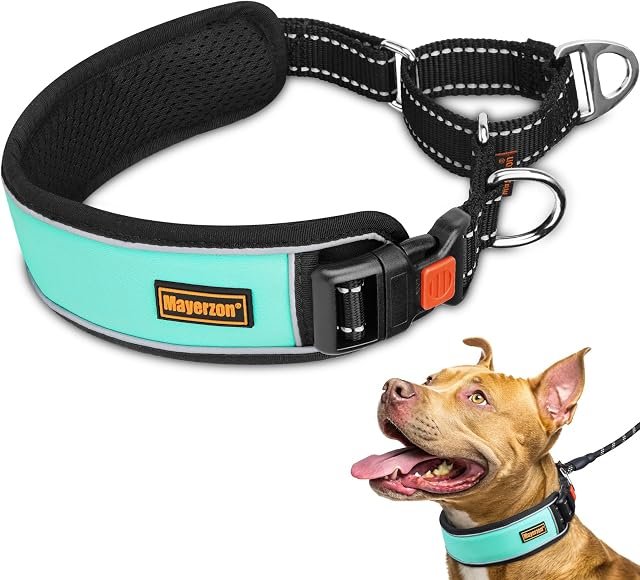
Mayerzon 2″ Padded Martingale Collar (XL) – Escape-Proof
Giant sighthound crosses and narrow-headed giants (Great Dane types, lurchers) can back out of flat collars with alarming ease — the Mayerzon 2-inch m
As an Amazon Associate, Dogslifelearning earns from qualifying purchases.
Product Description
Some dogs do not pull forward so much as reverse. Sighthound crosses, Great Danes, lurchers and other narrow-headed giants can back out of a flat collar in a single twisting motion, and once they are loose near a road, nothing about that moment feels theoretical. The Mayerzon 2-inch martingale collar in XL is built specifically for that problem.
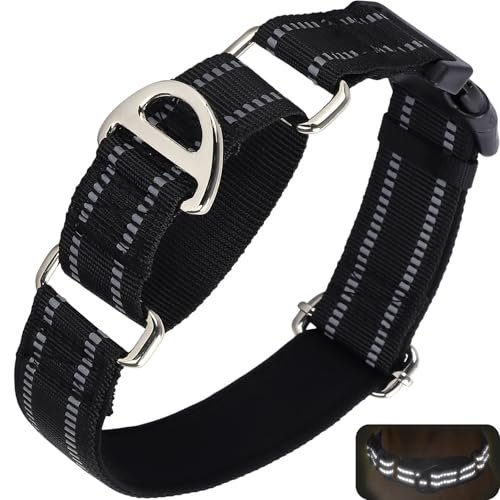
Instead of a fixed loop, the collar uses a limited-slip martingale cinch: when the dog pulls backward, the loop tightens just enough to close the escape gap, then relaxes the moment tension releases. The cinch has a preset stopping point, so control comes from geometry rather than pressure on the trachea — no choking, just a collar that cannot be backed out of.
The 2-inch webbing spreads force across the neck instead of concentrating it on a narrow band, and Mayerzon lines it with neoprene so the broad surface stays comfortable against skin and coat, even under a strong pull. Reflective stitching woven through the webbing adds after-dark visibility on evening walks. A quick-release buckle allows easy on and off without sliding the collar over narrow heads, and stainless steel D-rings give you a solid, rust-resistant leash attachment point.
Fit is everything with a martingale. Measure the neck snugly and size so the cinched loop closes to roughly neck circumference at its tightest — snug when tension is applied, a relaxed loose loop on a slack leash. This is a walking and training collar for escape-prone giants; like all martingales, it is not a tie-out collar and should not be left on an unsupervised dog. Rinse the neoprene lining after muddy or sweaty outings and check the stitching periodically. If your giant breed keeps backing out of collars, check it on Amazon and end the escape routine for good.
Frequently Asked Questions
How do I measure my dog for a martingale collar?
Measure two spots: the widest part of your dog's head (usually under the chin and up around the ears) and the neck where the collar will sit. Take the larger of the two measurements and add 1-2 inches for adjustment room. Since martingale collars slip over the head, the head measurement is the critical one — the collar must clear it, then cinch down snugly on the neck.
Will this martingale collar stop my dog from slipping out of it?
Yes, that's exactly what martingale collars are designed for. When your dog pulls or tries to back out, the control loop tightens the collar just enough to prevent escape — unlike a flat buckle collar that a determined dog can slip. When the leash is slack, it hangs loose and comfortable. Sighthounds like Greyhounds and Whippets, famous escape artists, are the classic martingale breed for this reason.
Is a 2-inch wide collar too wide for my dog?
The 2-inch width is made for large and giant breeds (think Great Danes, Mastiffs, German Shepherds) and long-necked sighthounds. Wider collars distribute pressure over more surface area, which is gentler on the throat than a narrow collar on a big, strong dog. For dogs under about 50 lbs, a 1-inch or 1.5-inch martingale is usually the better fit.
Does the neoprene padding make a difference?
Yes. The neoprene lining cushions the nylon webbing against your dog's neck, reducing chafing and irritation — especially valuable for short-coated breeds where bare nylon can rub. It's also quick-drying and easy to wipe clean after muddy walks.
Can I leave a martingale collar on my dog all day?
It's best to remove it when unsupervised. Because the control loop can snag on crates, fences, or branches, martingales shouldn't be worn during unsupervised play or in a crate. Use it for walks and training, then switch to a flat ID collar for all-day wear.
You May Also Like